Most building owners in Ohio don’t think about their gutters until something goes wrong. A warehouse floor is wet, a loading dock is flooding, or a tenant is complaining about water pouring over the entrance. By that point, the problem has usually been developing for months. Undersized gutters, failed joints, improper slope, or a drainage system designed for a milder climate have been quietly losing the fight against Northeast Ohio’s weather.
Commercial buildings face a precipitation load that most national gutter specifications simply aren’t built for. Northeast Ohio averages over 38 inches of rainfall annually, with snowfall regularly exceeding 60 inches in lake-effect corridors across Cuyahoga, Lake, and Lorain counties. Flat or low-slope commercial roofs common on warehouses, office parks, medical buildings, and retail strip centers collect and concentrate that water over massive surface areas before it ever reaches a downspout. When the gutter system isn’t matched to that volume, the building pays the price.
At a Glance: What This Guide Covers
- How commercial gutters differ from residential systems
- The right gutter size and profile for Ohio commercial buildings
- Material options: aluminum, steel, copper, and custom fabrication
- Flange-back gutters, scupper boxes, and industrial drainage solutions
- Ohio freeze-thaw damage and how properly installed systems prevent it
- When to repair vs. replace commercial gutters in Ohio
How Commercial Gutter Systems Differ From Residential Installations?
The gap between a residential and commercial gutter installation system isn’t just about size, it’s about the entire engineering approach. A home’s gutter manages rainfall from a few hundred square feet of roof surface. A commercial building might direct runoff from 10,000, 50,000, or 200,000 square feet through a coordinated drainage network that includes gutters, downspouts, scupper boxes, internal roof drains, and underground discharge systems.
On a standard Ohio house, a clogged gutter is an inconvenience. On a warehouse or office building, the same failure translates to interior flooding, structural damage to steel or masonry, slip-and-fall liability at entrances, and potential HVAC or electrical damage when water migrates through the building envelope. The stakes are different, and the system has to reflect that.
Key Differences Between Commercial and Residential Gutter Systems
| Factor | Residential | Commercial |
|---|---|---|
| Gutter Size | 5-inch standard | 6-inch, 7-inch, or custom box gutter |
| Roof Surface | Area 1,500–3,500 sq ft typical | 10,000–500,000+ sq ft |
| Drainage Complexity | Simple linear gutters + downspouts | Gutters, scuppers, internal drains, leaders |
| Material Gauge | Standard .027 aluminum | Heavy-gauge .032–.040+ aluminum or steel |
| Load Tolerance | Standard snow and rain | Heavy snow, ice, ponding water, equipment load |
| Failure Cost | Cosmetic damage, minor rot | Interior flooding, structural, liability |
| Installation | 1-day residential crew | Engineered, staged, often scaffolded |
Sizing Commercial Gutters for Rainfall and Snow Load
Gutter sizing for commercial buildings in Ohio is not a guessing game, it’s an engineering calculation based on roof surface area, roof pitch, regional rainfall intensity, and the number and placement of downspouts. Getting this wrong in either direction is costly: undersized gutters overflow and damage the building; unnecessarily oversized systems waste material budget and create unnecessary weight load on commercial fascia systems.
Gutter Size Reference for Ohio Commercial Buildings
| Roof Drainage Area (sq ft) | Recommended Minimum Gutter Size |
|---|---|
| Up to 2,000 sq ft | 5-inch K-style or half-round |
| 2,001 – 5,000 sq ft | 6-inch K-style (standard commercial) |
| 5,001 – 10,000 sq ft | 7-inch K-style or box gutter |
| 10,001 – 25,000 sq ft | Custom box gutter or internal drain system |
| 25,000+ sq ft | Engineered internal roof drain + scupper system |
For multi-bay warehouses and large retail facilities, the drainage is typically split into zones, with each zone calculated independently. A 50,000 sq ft warehouse doesn’t run a single gutter around the entire perimeter. It uses a combination of internal roof drains, exterior gutters on lower roof sections, and scupper boxes at parapet walls to manage water across multiple drainage planes.
Why Ohio’s Lake-Effect Snow Load Changes the Calculation
Standard commercial gutter specs often assume precipitation arrives as rainfall. In Northeast Ohio, that assumption fails every winter. When lake-effect snow accumulates on a flat commercial roof and the temperatures rise above freezing during the day, the melt volume hitting gutters can exceed what even a well-sized system expects. This is compounded by ice damming: when gutters themselves freeze overnight, meltwater backs up under roofing membranes and into the building.
For commercial buildings, this means sizing up from the SMACNA baseline, specifying heavier hanger systems at closer intervals, and ensuring downspouts are not only adequate in diameter but positioned to drain away from loading docks, entrance canopies, and high-traffic areas where ice discharge creates hazards.
Gutter Profiles and Materials for Commercial Buildings
Not every commercial building needs the same gutter profile. The right choice depends on roof geometry, the building’s structural fascia system, aesthetic requirements, and the level of water volume the system must manage. Below are the primary profiles used in Ohio commercial gutter installations cleveland and where each performs best
K-Style Gutters
K-style gutters are the most widely specified profile for commercial buildings in Ohio. Their flat back and decorative front profile allow them to mount directly to vertical fascia boards or fascia brackets without requiring a custom mounting system, which keeps installation cost down on standard construction. The K-profile also carries more water volume per inch of width than a half-round profile important when you’re managing high-intensity storm events.
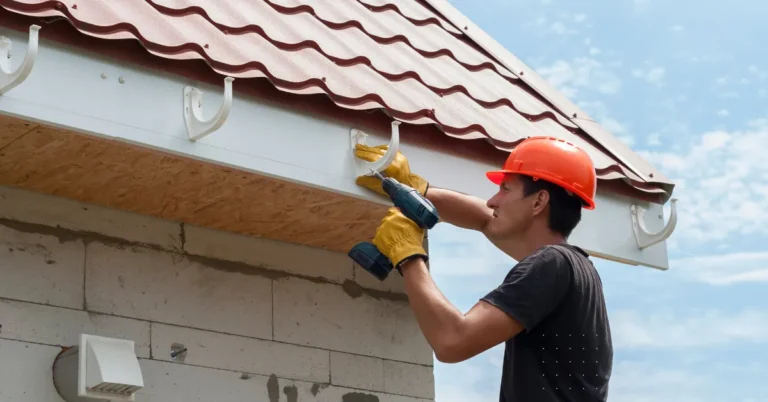
For commercial applications, we install K-style in 6-inch and 7-inch widths using heavy-gauge aluminum (.032 minimum for commercial, .040 for high-load applications) or galvanized steel where additional rigidity is required. All commercial K-style gutters are fabricated on-site as seamless runs eliminating the joints that are the primary failure point in sectional commercial gutter systems.
Box Gutters
Box gutters also called built-in gutters or parallel gutters. They are used on commercial buildings where roof volume is too high for surface-mounted K-style systems, or where the architectural design integrates the gutter into the roofline itself. They’re common on older Ohio commercial and industrial buildings constructed before K-style became the standard, and they are still specified today for high-volume drainage zones and certain architectural styles.
Box gutters require careful attention to slope, liner material, and expansion joint placement. Because they hold significantly more water volume than surface-mounted systems, a liner failure or improper slope in a box gutter can create a hidden water reservoir over the building structure — leading to rot, corrosion, and eventually structural damage. We fabricate and install box gutters in copper, aluminum and galvanized steel depending on the building’s requirements.
Flange-Back Gutters
Many commercial buildings particularly industrial facilities, older brick warehouses, and buildings with EIFS (exterior insulation and finish systems) facades don’t have a traditional wood fascia to mount a standard gutter bracket against. Flange-back gutters solve this problem with an integrated mounting flange that fastens directly to the building’s structural wall or masonry, eliminating the need for a fascia mounting system entirely.
Flange-back systems are also preferred on commercial buildings where the roofline transitions occur at parapet walls rather than exposed rafters. The flange-back profile creates a weather-tight connection between the gutter and the building envelope, reducing the infiltration risk that’s common when standard gutters are retrofitted to masonry or metal panel facades.
Copper Gutters
Copper gutters are specified on premium commercial properties corporate headquarters, historic buildings, medical campuses, and high-end retail where the gutter system is also a visible architectural element. Copper’s natural patina development over time is a desired aesthetic outcome on these buildings, and its lifespan — 50 years or more with proper copper gutter installation justifies the higher upfront material cost on long-term commercial holds.
For Ohio commercial buildings, copper gutters also carry a practical advantage: copper is naturally antimicrobial and resists the algae and biological growth that discolors aluminum systems in shaded or humid locations. On buildings near Ohio’s tree canopy corridors or in wooded corporate campuses, that matters.
Scupper Boxes and Industrial Drainage Systems for Ohio Commercial Roofs
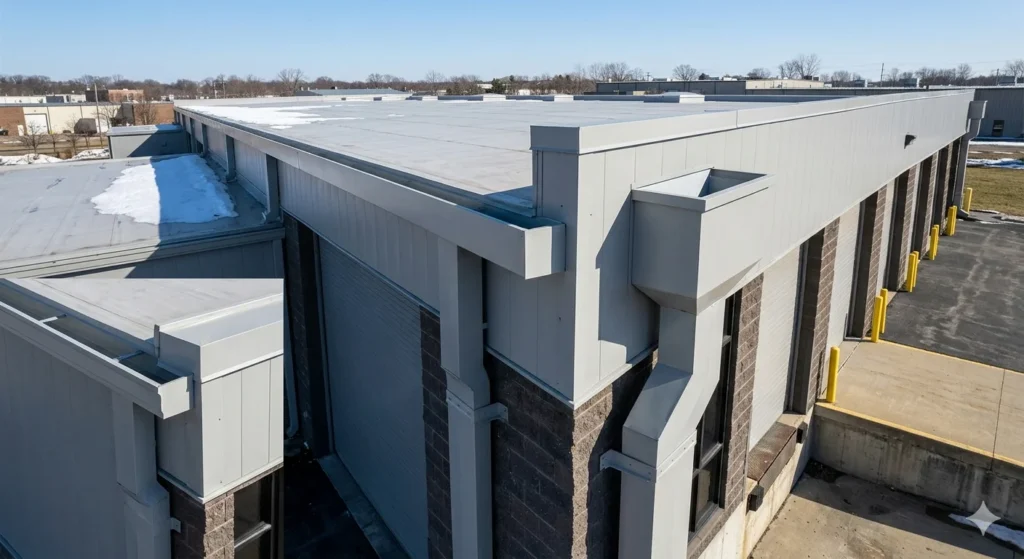
On flat-roof Ohio commercial buildings the majority of warehouses, big-box retail, office complexes, and industrial facilities the primary drainage system isn’t a surface gutter at all. It’s a network of internal roof drains, scupper boxes at parapet walls, and outlet downspouts that move water off the roof and away from the building perimeter. Gutters, where present, handle secondary drainage from lower roof slopes and canopy sections.
What Is a Scupper Box and When Does a Commercial Building Need One?
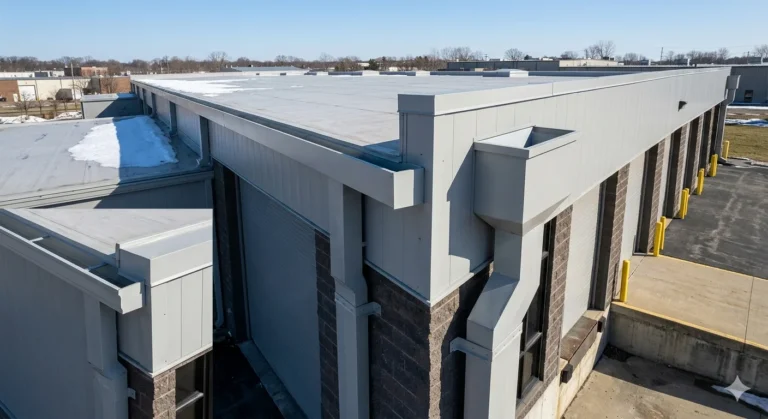
A scupper is an opening in a parapet wall or raised roof edge that allows water to flow off the roof when internal drains are overwhelmed or as the primary drainage route. A scupper box is the fabricated metal component typically aluminum or galvanized steel that frames that opening, directs water flow, and connects to a downspout or conductor head below.
In Ohio, scupper boxes are required by building code on most flat and low-slope commercial roofs as either a primary or overflow drainage mechanism. When internal drains ice over during a Northeast Ohio freeze event, the scupper box is the emergency overflow that prevents the roof from ponding water to the point of structural overload. A flat roof holding six inches of standing water over 20,000 square feet is carrying over 600,000 pounds of load the scupper is what prevents that scenario.
Industrial Gutter Systems
Industrial buildings in Ohio present drainage challenges that go well beyond what standard commercial specifications address. A 200,000 sq ft distribution center, a steel-framed manufacturing facility, or a multi-bay agricultural building has not just massive roof surface area but also structural and operational constraints that affect how gutters can be installed, accessed, and maintained.
For Ohio industrial facilities, we design and install oversized aluminum and steel gutter systems with engineered hanger spacing rated for Ohio’s snow load, conductor heads that manage high-velocity downspout discharge without erosion at the building’s foundation, and debris management systems that keep industrial downspouts clear without requiring frequent manual maintenance. Industrial gutter systems are also installed to minimize conflict with dock levelers, overhead doors, and exterior equipment that’s often positioned along the building perimeter.
Ohio Freeze-Thaw Cycles and What They Do to Commercial Gutter Systems
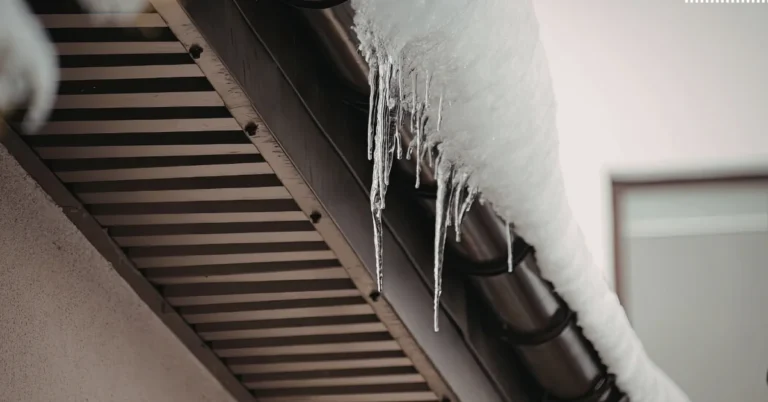
No single weather phenomenon is more destructive to Ohio commercial gutter systems than the freeze-thaw cycle. Unlike a single extreme cold event which a properly installed system can handle the freeze-thaw cycle attacks gutters through repetition. Every time water in a gutter joint, seam, or bracket mounting hole freezes and expands, it works the material slightly. Over a single Northeast Ohio winter, that process can repeat dozens of times. By spring, what was a tight commercial gutter installation is showing separated joints, pulled hangers, and cracked end caps.
For Ohio commercial buildings, this means that gutter installation decisions made in summer or fall will face their first serious test within weeks. The quality of hanger installation, the quality of joint sealing, and the quality of the metal itself all determine how many freeze-thaw cycles a commercial gutter system survives before requiring repair.
What Freeze-Thaw Damage Looks Like on Ohio Commercial Gutters
| Damage Type | What’s Actually Happening |
|---|---|
| Gutter pulling away from fascia | Hanger screws are working loose as freeze-thaw expands and contracts the mounting point |
| Leaking at joints and miters | Sealant has fractured from thermal cycling — water is now entering the joint directly |
| Sagging gutter sections | Hanger failure is allowing the gutter to drop, creating low points where water and ice pool |
| Cracked end caps | Ice formation inside the gutter is splitting end cap welds or factory seams |
| Overflowing gutters in mild weather | Ice dam inside the gutter is blocking flow — water overflows at the lowest failure point |
| Rust staining on masonry or siding | Water is bypassing the gutter entirely through a failed joint or cracked section |
| Soft or rotting fascia boards | Long-term water infiltration behind the gutter — often means full fascia replacement needed |
The solution to freeze-thaw damage on Ohio commercial buildings isn’t reactive repair it’s installation quality from the start. Heavy-gauge aluminum at appropriate hanger intervals, professional-grade polyurethane sealant at all joints, and proper slope calculation that keeps water moving rather than pooling are the foundation of a commercial gutter system that survives Ohio winters repeatedly.
Soffit and Fascia Integration on Ohio Commercial Buildings
Commercial gutter systems don’t exist in isolation they’re part of a building envelope system that includes the soffit, fascia, and in many cases a drip edge or metal coping system at the roof edge. When a commercial gutter fails in Ohio, it rarely fails alone: water infiltrating behind a gutter typically damages the fascia board or metal fascia channel it’s mounted to, and if that damage goes unaddressed, the next gutter installation is inheriting a compromised substrate.
Before any commercial gutter installation, Gutters Unlimited LLC inspects the fascia substrate for rot, corrosion, delamination, or structural compromise. On older Ohio commercial building particularly those with wood-framed fascia systems from the 1960s through the 1990s we frequently find fascia boards that have been saturated repeatedly and are no longer structurally sound enough to hold commercial hanger loads through an Ohio winter. Replacing fascia before gutter installation isn’t an upsell it’s the difference between a system that lasts 20 years and one that fails in three.
When to Repair vs. Replace Commercial Gutters on Ohio Buildings
One of the most common questions Ohio building owners and property managers face is whether to repair a failing commercial gutter system or replace it entirely. The answer depends on the age of the system, the extent of damage, the quality of the original installation, and whether the underlying substrate is still sound.
Repair Makes Sense When:
The gutter system is fewer than 10 years old and the damage is isolated a single sagging section, a failed joint, a cracked end cap. Spot repairs on a structurally sound, properly sized commercial gutter system are cost-effective and can extend the system’s life by another decade if the underlying issue (hanger quality, slope, joint sealing) is corrected rather than just patched. On Ohio commercial buildings, post-winter inspection is the right time to identify and repair isolated freeze-thaw damage before it escalates.
Replacement Makes Sense When:
The gutter system is over 15–20 years old, damage is widespread across multiple sections, or the original installation was undersized for the building’s roof drainage area. Ohio commercial buildings that have experienced repeated flooding, ongoing fascia rot, or structural damage from years of gutter failure need a full system replacement — not continued repair of a fundamentally inadequate system. Replacement is also the right call when a building undergoes a significant renovation that changes the roof geometry or drainage requirements.
FAQs
What gutter size do most Ohio commercial buildings need?
Most single-story commercial buildings in Ohio use 6-inch K-style gutters, while larger roof areas over 5,000 sq ft per drainage zone typically require 7-inch systems or custom box gutters. Proper sizing should always be based on roof area calculations and regional rainfall data—not visual estimates.
How often should commercial gutters in Ohio be inspected?
At minimum, twice per year—once in late fall before freezing conditions and again in early spring after snowmelt. Additional inspections are recommended after severe storms, especially hail, and for properties with heavy tree coverage.
Do Ohio commercial buildings need gutter guards?
Gutter guards are highly beneficial for buildings in wooded or debris-prone areas, helping prevent clogs and reduce freeze-thaw damage. For open industrial sites with minimal tree exposure, they are less essential.
What is the difference between a commercial gutter and an industrial gutter?
Commercial gutters are designed for standard properties like offices and retail buildings, while industrial systems are built for larger facilities and use heavier materials, wider profiles, and reinforced supports to handle higher water volumes.
Can commercial gutters be installed in Ohio’s winter months?
Yes, installation can be done year-round, but sealants typically require temperatures above 40°F to cure properly. Experienced contractors adjust installation methods to accommodate winter conditions.
Conclusion
Gutters Unlimited LLC designs and installs high-performance commercial gutter installation Cleveland systems across Northeast Ohio—from 6-inch K-style systems on retail centers to engineered drainage solutions for large warehouses throughout Cuyahoga County. If your building is dealing with drainage issues, aging gutters, or you’re planning a new construction project, our team will evaluate your roof, perform accurate drainage calculations, and provide a clear, no-obligation commercial quote.